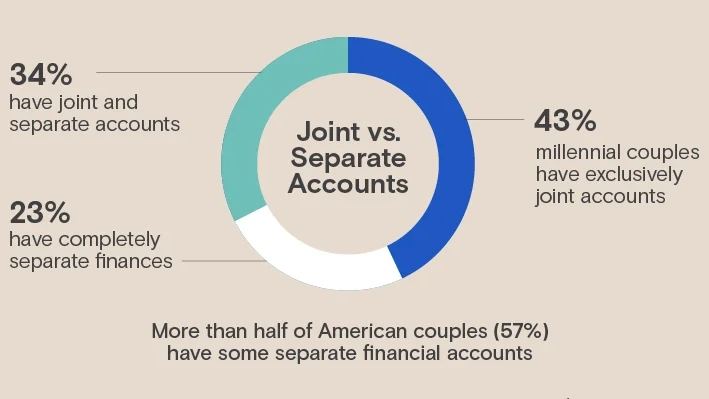
Deciding how to manage money as a couple is about more than choosing a bank account. It affects how partners pay bills, save for major purchases, handle financial emergencies, and make decisions about their future. While some couples combine every dollar into a joint account, others prefer to keep their finances separate. A growing number choose a hybrid system that combines shared money with individual accounts.
Which arrangement works best? The answer often depends on the stage of the relationship. A couple who has recently moved in together may have very different financial needs from newlyweds, parents raising children, or partners approaching retirement.
Instead of assuming there is one ideal arrangement, couples should choose a system that matches their responsibilities, income, and long-term goals.
1. When You Are Dating: Keep Financial Commitments Simple
Couples who are dating but have not yet combined their households usually have fewer shared financial obligations. They may pay for occasional dinners, weekend trips, entertainment, or vacations together, but they generally maintain separate housing and other major expenses.
At this stage, separate accounts are often the simplest choice.
Each person retains control of their income, savings, and debt payments. There is no need to combine financial records or create a shared account before both partners understand each other’s spending habits.
However, dating couples can still benefit from discussing money. If one person regularly earns more, they should talk about whether splitting expenses equally feels comfortable. One partner should not feel pressured to spend beyond their budget simply to maintain a particular lifestyle.
For shared trips or larger purchases, couples can create a simple savings plan. Each person contributes an agreed amount toward the expense without transferring ownership of their broader finances.
The key principle is to match financial integration to actual shared responsibilities rather than relationship labels.
2. Moving In Together: Introduce a Shared Expense System
Moving into the same home creates new financial responsibilities. Rent, electricity, internet, groceries, household supplies, and renters insurance can quickly become complicated when every expense is paid separately.
A hybrid system can help.
Both partners maintain individual checking accounts and open a joint account for household expenses. Each month, they transfer an agreed contribution into the shared account. Rent and recurring bills are paid from that account, while personal expenses remain separate.
Consider a couple with combined monthly take-home income of $7,000 and shared expenses of $2,800.
If they contribute equally, each deposits $1,400. If one partner earns $4,500 and the other earns $2,500, however, an income-based contribution may feel more manageable.
Their income shares are approximately 64% and 36%. Using those percentages, the higher earner contributes about $1,800 and the lower earner contributes about $1,000.
Neither formula is automatically correct. The couple should also consider personal debts, childcare obligations, and other financial commitments.
Before signing a lease, agree on what happens if one partner loses a job, moves out, or cannot pay their share. These discussions may feel uncomfortable, but they are easier before a financial emergency occurs.
3. Marriage: Decide Whether to Combine More of Your Finances
Marriage often introduces additional shared responsibilities, including long-term savings, insurance, homeownership, and retirement planning.
Some married couples choose fully joint finances because they view income and expenses as part of one household. Others retain separate accounts because they prefer individual control. A hybrid arrangement remains a reasonable option.
The important consideration is how the couple defines financial partnership.
For example, one spouse might earn $90,000 annually while the other earns $45,000. If both contribute half of their household expenses, the lower-earning spouse may have considerably less money available for personal savings.
A couple that views income as a shared household resource might instead create a joint budget covering necessities, agreed savings, and discretionary spending. They can then decide how much personal spending money each spouse receives.
Another couple might maintain separate accounts but contribute proportionally to shared costs.
Both approaches can work, provided the rules are clear and both partners have meaningful participation in financial decisions.
Marriage does not automatically require combining every bank account. However, spouses should understand that legal obligations, property rights, and responsibility for debts vary by state and circumstance. Account structure alone does not determine every legal consequence.
4. Having Children: Account for Unpaid Work and Unequal Income
Parenthood can change a household’s financial structure dramatically.
One parent may reduce working hours, leave a job, or take responsibility for most childcare. As a result, household income may become concentrated in one person’s paycheck even though both partners contribute to the family’s well-being.
A strict 50/50 approach may no longer reflect the household’s reality.
Suppose one spouse works full-time while the other stays home with a child. The stay-at-home parent may have little or no earned income, but their unpaid work supports the family’s daily functioning and may reduce childcare costs.
In this situation, fully joint finances or a carefully designed hybrid arrangement can ensure that both partners have reasonable access to household money.
Couples should budget for childcare, healthcare, education, emergency savings, and retirement contributions where possible. They should also discuss how the nonworking partner will maintain financial security and access to funds.
A household should not treat one person’s income as exclusively theirs while expecting the other person to provide unpaid labor without financial autonomy.
The account system should reflect the reality that a family depends on more than a paycheck.
5. Buying a Home: Separate Accounts Require Clear Agreements
Purchasing a home introduces new questions about down payments, mortgage payments, repairs, property taxes, and ownership.
A joint checking account can simplify mortgage payments and household bills. However, couples who maintain separate accounts should still agree on how they will fund these costs.
Consider a couple buying a $400,000 home. One partner contributes most of the down payment, while both plan to make monthly mortgage payments.
They should discuss how the down payment affects their ownership expectations, whether mortgage contributions will be equal or proportional, and how major repairs will be funded.
A joint account does not automatically establish equal ownership of a property. Property title, loan documents, marital status, and applicable law can affect the outcome.
For unmarried couples, a written co-ownership agreement may be particularly useful. For married couples with significant assets or unequal contributions, professional legal advice can clarify potential risks.
The goal is to avoid assuming that a bank-account arrangement resolves every question about a major asset.
6. Career Changes and Financial Emergencies: Build Flexibility Into Your System
Financial circumstances can change quickly. A layoff, medical expense, career change, or period of caregiving may reduce one partner’s income.
An account structure that worked comfortably last year may become difficult to maintain.
Couples should establish a plan for temporary income changes before they occur. Decide whether contributions will be adjusted, which expenses can be reduced, and how emergency savings will be used.
For example, a couple using proportional contributions can recalculate their shares when one person temporarily earns less. They may also agree that both partners will contribute according to their available resources during a period of unemployment.
Maintaining some personal savings can provide flexibility, but emergency planning should not replace transparent communication about shared obligations.
A useful rule is to review the arrangement whenever there is a major life change rather than waiting for financial stress to turn into an argument.
7. Approaching Retirement: Coordinate Without Losing Independence
As couples approach retirement, the focus often shifts from monthly bills to retirement income, healthcare costs, Social Security benefits, investment withdrawals, and estate planning.
Separate accounts may preserve clear records of individual assets, while joint accounts can simplify shared living expenses. A hybrid structure can accommodate both needs.
Partners should calculate their expected household income and expenses, identify potential shortfalls, and agree on how retirement costs will be divided.
They should also review beneficiaries, wills, insurance, and powers of attorney where appropriate. Retirement planning can involve tax and legal considerations that cannot be resolved simply by combining bank accounts.
Couples with different retirement savings balances should discuss how those differences affect their plans without assuming that one account structure is suitable for everyone.
8. Create a System That Evolves With Your Relationship
A practical account arrangement should be flexible enough to change over time.
Start by listing shared expenses, individual obligations, and joint savings goals. Decide which account will pay each bill, how contributions will be calculated, and how much personal spending freedom each partner will retain.
Automate transfers when possible and schedule a monthly review. Discuss whether the current system remains affordable and whether either partner feels financially restricted.
A simple framework is:
- Dating: maintain individual accounts and agree on shared purchases.
- Moving in together: consider a joint household-expense account.
- Marriage or parenthood: review whether income and responsibilities require a more integrated budget.
- Homeownership or retirement: coordinate major assets, savings, and legal planning.
These are options, not mandatory milestones. Some couples keep separate finances throughout their relationship, while others prefer joint accounts from the beginning.
Conclusion
The right bank-account system should reflect the life a couple is actually living. Separate accounts may suit partners who are building independence, joint accounts may simplify highly integrated household finances, and hybrid accounts may offer a practical middle ground.
Revisit the arrangement as income, family responsibilities, and financial goals change. When both partners understand the rules and have a voice in decisions, the account structure becomes a tool for cooperation rather than a source of conflict.