
Money disagreements can begin with something as ordinary as a grocery bill and grow into arguments about fairness, independence, and trust. One partner may wonder why the other spends so much on personal interests. The other may feel frustrated about having to explain every purchase.
Often, the problem is not the bank account itself. It is the absence of clear rules.
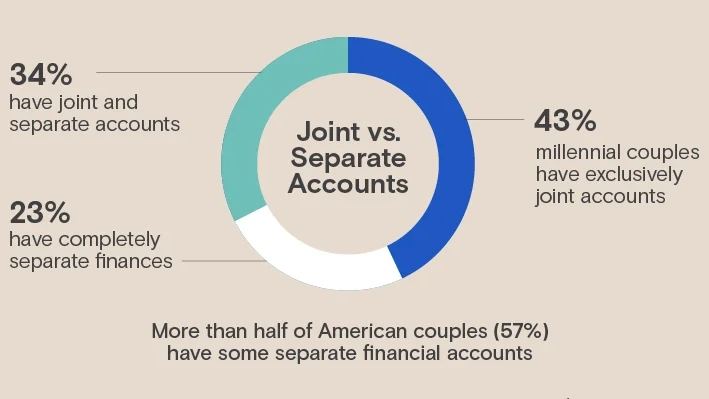
Couples can use joint accounts, separate accounts, or a hybrid system successfully, but each arrangement requires agreements about spending, savings, responsibilities, and financial privacy.
The most effective system is not necessarily the one that combines the most money. It is the one that makes everyday decisions predictable while allowing both partners to participate fairly.
1. Agree on What Counts as Shared Money
Before choosing an account structure, identify which expenses belong to the household and which remain individual responsibilities.
Shared expenses commonly include rent or mortgage payments, utilities, groceries, household supplies, and agreed-upon insurance costs. Depending on the relationship, they may also include childcare, vacations, pets, and long-term savings.
Personal expenses might include individual hobbies, clothing, gifts, entertainment, or purchases that do not affect shared obligations.
There is no universal list. One couple may consider gym memberships a personal expense, while another may include family fitness costs in its shared budget.
The important point is to decide in advance.
Without an agreement, one partner may expect shared funds to cover a purchase while the other considers it unnecessary personal spending.
A written list can prevent recurring arguments. Review it whenever circumstances change, such as moving to a new home, having children, or taking on additional debt.
2. Establish a Spending Threshold
Couples do not need to discuss every small purchase. However, larger expenses can affect savings goals and monthly cash flow.
A spending threshold creates a practical boundary.
For example, partners might agree to discuss any unplanned purchase above $250 when it will come from shared funds. Another couple may choose $100 or $500, depending on income and financial circumstances.
The threshold should apply consistently rather than giving one partner more freedom than the other.
It should also distinguish between discussing a purchase and requesting permission to spend personal money. If each partner has an agreed personal budget, they should generally be able to use it independently.
For shared purchases, the rule might be:
- Confirm that essential bills are covered.
- Check whether the purchase affects agreed savings goals.
- Discuss the expense if it exceeds the threshold.
- Decide together whether to buy now, save first, or choose a less expensive alternative.
This approach creates accountability without turning ordinary spending into a constant negotiation.
3. Choose a Contribution Formula That Feels Fair
One of the most important decisions is how each partner funds shared expenses.
There are three common approaches.
Equal contributions: Each partner contributes the same dollar amount. This is straightforward and can work well when incomes and obligations are similar.
Proportional contributions: Each partner contributes according to their share of combined income. This can help balance the burden when incomes differ.
Needs-based contributions: The couple considers income, debt, childcare, medical costs, and other obligations to determine a sustainable arrangement.
Consider a couple with take-home incomes of $4,800 and $3,200. Their combined monthly income is $8,000, and shared expenses total $3,200.
Under an equal arrangement, each contributes $1,600.
Under a proportional arrangement, the first partner contributes 60%, or $1,920, while the second contributes 40%, or $1,280.
The equal arrangement may be acceptable if both partners have similar financial obligations. The proportional arrangement may be preferable if the couple wants each person to contribute the same percentage of income.
Neither method automatically accounts for every circumstance. A partner supporting a child from a previous relationship, paying substantial medical expenses, or repaying student loans may need a more individualized agreement.
The best formula is one both partners understand and can maintain without repeatedly falling behind.
4. Automate the Hybrid Account System
A hybrid account structure becomes much easier to manage when contributions happen automatically.
Each partner receives income in an individual account and transfers an agreed amount into a joint checking account. Household bills are paid from the joint account, while remaining funds stay available for individual spending and savings.
Suppose monthly shared expenses total $2,600. The couple agrees that one partner contributes $1,560 and the other contributes $1,040.
They can schedule these transfers shortly after payday. If their income is paid on different dates, they can choose transfer dates that ensure enough money is available before bills are due.
It is also sensible to maintain a buffer in the joint account for small changes in utility bills or other irregular expenses.
The system should include a procedure for reviewing contributions when costs rise. If rent increases or a new insurance premium begins, both partners should know how the additional expense will be funded.
Automation reduces missed transfers, reimbursement requests, and unnecessary calculations. It does not eliminate the need to review the budget periodically.
5. Protect Personal Spending Without Hiding Financial Problems
Personal financial autonomy can be important even in a long-term marriage.
Each partner may want to buy books, pursue hobbies, meet friends, or save for a personal goal without explaining every transaction. A hybrid system can make this easier by separating personal spending from household expenses.
However, privacy should not become a way to conceal information that materially affects the relationship.
For example, a large undisclosed loan, gambling losses, or an inability to pay an agreed household contribution can affect both partners. These issues require honest discussion.
A useful distinction is between private discretionary choices and financial obligations that affect the household.
Couples can agree that purchases from personal accounts do not require approval, provided shared bills are paid, agreed savings contributions are maintained, and neither partner takes on undisclosed obligations that threaten shared goals.
This gives both people independence while preserving accountability.
6. Build Savings Rules Into the Account Structure
A common budgeting mistake is treating savings as whatever remains after spending.
Couples can reduce this problem by making savings a planned expense.
They might establish separate targets for emergency reserves, vacations, home repairs, a down payment, or retirement. Some goals may be shared, while others remain individual.
For example, a couple could automatically transfer $400 per month into joint savings after funding essential expenses. Each partner might also contribute to personal savings according to their own budget.
The exact amounts should depend on income, debt, and upcoming obligations. A household with high-interest debt or an unstable income may need a different priority order from one preparing for a home purchase.
An emergency fund can help cover unexpected expenses or temporary income loss. The appropriate target varies, but couples can start by calculating essential monthly costs and gradually building a reserve.
Decide in advance which circumstances justify using shared emergency savings and how the fund will be replenished afterward.
7. Plan for Unequal Contributions and Unpaid Work
Financial fairness becomes more complicated when one partner earns less or performs more unpaid household work.
A partner who works fewer paid hours to care for children may contribute less cash but provide substantial economic value to the household.
If the couple uses separate accounts, the lower-earning partner may have difficulty building personal savings or retirement assets. A strict 50/50 arrangement can make this problem worse.
Partners should discuss how household labor, caregiving, and income differences affect their financial agreement.
Possible solutions include proportional contributions, shared access to household funds, an agreed personal spending allowance for each partner, and retirement planning that accounts for periods of unpaid caregiving where legally and financially appropriate.
The goal is not to assign an exact dollar value to every household task. It is to recognize that a fair partnership should consider both paid and unpaid contributions.
8. Create a Conflict-Resolution Rule Before You Need One
Even couples with similar values will occasionally disagree about money.
One partner may want to increase savings while the other prefers spending on travel. Unexpected repairs may require reducing discretionary expenses. A change in employment may force a complete budget revision.
Instead of trying to resolve these issues during an argument, establish a regular money meeting.
Once a month, review account balances, upcoming bills, spending patterns, and progress toward savings goals. Give each partner time to raise concerns without interruption.
When a disagreement arises, identify the underlying issue. Is it affordability, different priorities, a lack of information, or a feeling that contributions are unfair?
Then compare practical alternatives. You might delay a purchase, adjust contributions, reduce another expense, or create a separate savings target.
For recurring disagreements that cannot be resolved through ordinary budgeting discussions, a qualified financial counselor or couples therapist may help.
9. Know When Your Current System No Longer Works
A bank-account structure should be reviewed when income changes, a child arrives, debt increases, a partner changes careers, or the couple purchases property.
Warning signs include repeated overdrafts, missed bill payments, one partner consistently covering unexpected costs, or ongoing resentment about access to money.
Another warning sign is when one partner cannot access funds for essential needs or feels compelled to surrender financial independence. Such situations deserve careful attention and may require support beyond routine budgeting.
Couples should also understand the terms of their bank accounts, including withdrawal authority, fees, and what happens if the relationship ends.
For significant shared assets or complex legal circumstances, professional legal or tax advice can clarify questions that a budget alone cannot answer.
Conclusion
Joint accounts, separate accounts, and hybrid systems can all work when couples establish clear financial rules.
Decide what counts as shared money, how contributions will be calculated, which purchases require discussion, and how savings will be funded. Automate routine transfers and schedule regular financial reviews.
Most importantly, design the system around mutual respect rather than assumptions about what committed couples should do.
The purpose of a financial agreement is not to eliminate every disagreement. It is to make everyday money decisions easier, protect both partners’ financial well-being, and create a practical framework for working toward shared goals.